

Many projects start the same way.
Someone notices a problem. They imagine a solution. They say: “I have an idea.”
And very often, that idea quickly becomes precious. They think about it, protect it, become attached to it. They may even start projecting: the business name, the logo, the product, the revenue, the clients, the success.
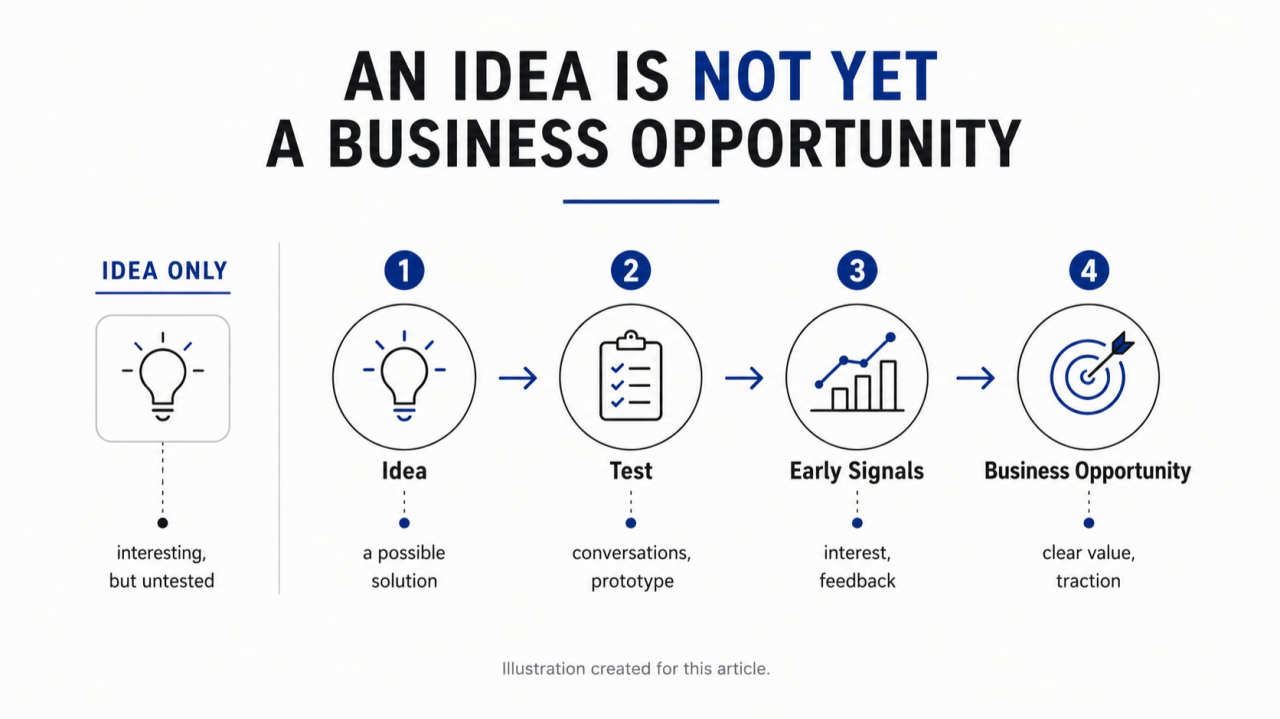
But an idea, however interesting it may be, is not yet a business opportunity.
It is a hypothesis.
A hypothesis that needs to be clarified, tested, adjusted, and turned into a credible response to an identified need.
In entrepreneurship, the danger is not only lacking ideas. Sometimes, the real danger is falling in love with an idea too early, before checking whether it responds to an actual need, whether potential clients are willing to engage with it, whether the required resources are available, and whether the risks are acceptable.
A good idea does not become a strong project simply because it sounds promising. It becomes stronger when it can stand up to the market, to constraints, and to the practical conditions of execution.
The idea must leave the entrepreneur’s mind
An idea becomes more serious when it moves out of imagination and begins to be tested with the right people.
That means asking simple but demanding questions.
What need does it address? Who actually experiences this problem? Who would be willing to pay for, use, recommend, or support this solution? What already exists on the market? How is the proposed offer different? What resources will be needed to implement it? What risks could weaken the project?
These questions are not meant to discourage the entrepreneur.
They are meant to protect the project.
Because an idea can feel very strong in the mind of the person carrying it, yet prove much more fragile in the market. Conversely, a simple idea, well aligned with a clear need, can become a real business opportunity.
That is often where the difference is made.
Before the business plan, there must be concrete signals
Many entrepreneurs move too quickly toward the business plan.
They have an idea and immediately want to put it into form: mission, target market, revenues, expenses, strategy, projections. The exercise is useful, of course, but sometimes it comes before the idea has truly been tested with the people it is meant to serve.
That is where the gap appears.
On paper, the project may seem coherent. But when a partner, funder, or institution starts asking concrete questions, assumptions are not enough.
Who has already shown interest? Who has tested it? Who has paid? Who came back? Which objections came up more than once? What customer habits have been observed?
These are the elements that give substance to a project.
A business plan becomes much stronger when it is supported by real traces: first clients, documented exchanges, CRM data, bank transactions, user feedback, orders, sign-ups, letters of interest, or early signs of traction.
Without this minimum experience, there is a risk of writing a serious document around an idea that is still fragile.
With it, you are no longer only describing what the project could become.
You are showing what it is already beginning to prove.
The client does not always see value where the entrepreneur sees it
One common trap is believing that the value of a project lies in what the entrepreneur finds interesting.
But value is mainly located where the client perceives it.
A product can be well thought out, well presented, and well designed, yet still fail to find its audience. Not because it is bad, but because it does not clearly respond to a priority, a frustration, an expectation, or a need that matters enough.
Knowing a client is not only about knowing their age, income, or location. It is about understanding how they make decisions, what they already use, the habits they have developed, the frustrations they accept for lack of a better option, and what could give them a real reason to try something else.
A strong project rarely begins with this question:
“Is my idea good?”
It begins with a better one:
“For whom does this idea truly create value?”
That nuance changes everything.
Testing early helps avoid costly mistakes
Testing an idea does not mean waiting until everything is perfect.
Quite the opposite.
It means moving forward with simple means in order to learn quickly.
A conversation with potential clients. A prototype. A pre-sale. A landing page. A simplified first offer. A discussion with partners or users.
The goal is not to prove that the idea is perfect.
The goal is to understand what needs to be adjusted before investing too much time, money, and energy.
Many projects benefit from being presented in a simple, almost minimal version, but one that is clear enough to trigger a reaction: interest, an objection, a sign-up, a payment, a recommendation, a request for more information.
These are the signals that matter.
Not only compliments.
Because there is a major difference between someone saying “that’s a good idea” and someone taking a concrete step.
Entrepreneurship requires intuition, but also lucidity
You need to believe in your idea enough to act.
But you also need to remain open enough to transform it.
That is one of the hardest balances for an entrepreneur: moving forward with conviction without becoming trapped in the first version of the idea.
An idea can change. A market can respond differently than expected. A client can reveal a more important need than the one you had imagined. A constraint can force you to simplify. An objection can become a path for improvement.
A project does not lose strength because it evolves.
On the contrary, it becomes stronger when it learns from the field.
What to remember
An idea is a starting point.
It may be brilliant, original, useful, or ambitious. But as long as it has not been tested against the need, the demand, the resources, the market, and the risks, it remains a hypothesis.
The real strength of an entrepreneur is not only having ideas.
It is knowing how to question them, test them, adjust them, and turn them into solutions capable of creating real value.
An idea only becomes a business opportunity when it stops being merely attractive.
It must become useful, understandable, executable, and strong enough to create value.