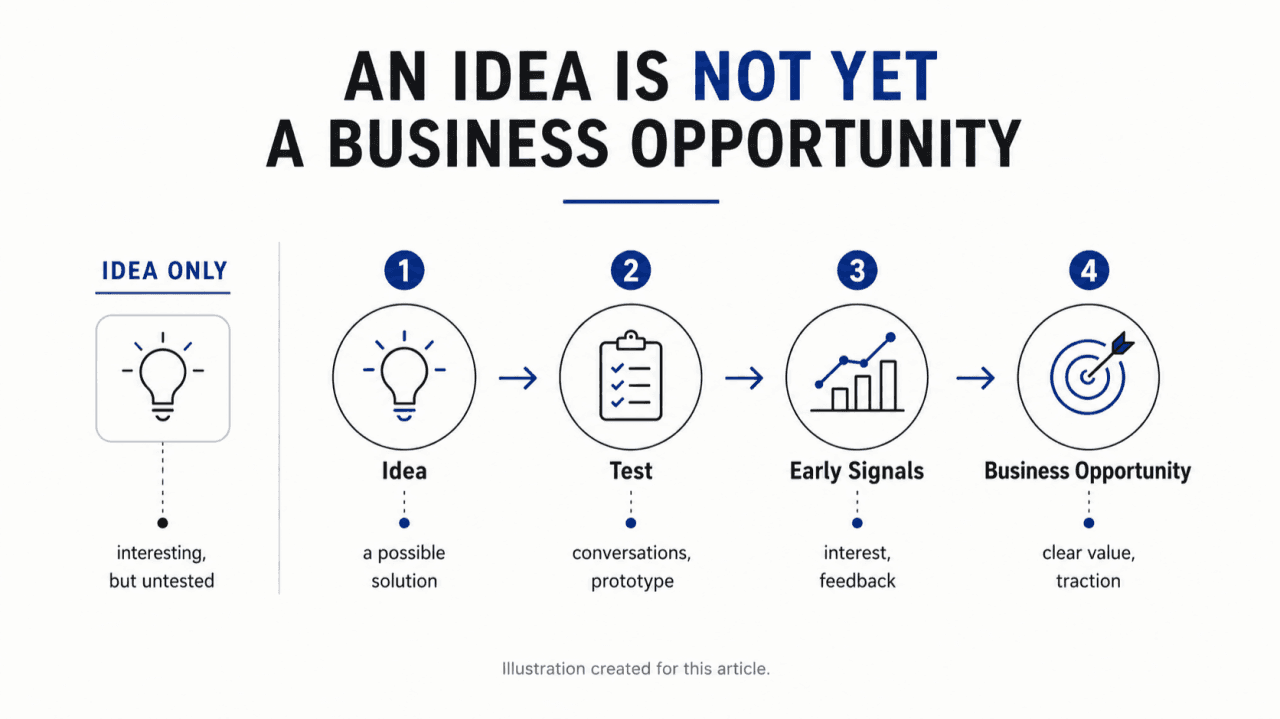


A business plan is not meant to prove that you have an idea.
It is meant to show that you understand what it will take to make that idea work.
That is often where the difference is made. Many projects look good on paper. They have a mission, an offer, a target market, a few numbers, and sometimes even a well-presented funding request. But when you look more closely, one question quickly appears: is the project truly understood, or merely well described?
A partner, funder, institution, or advisor is not looking for a polished presentation alone. They are looking for logic. They want to understand the need, the customer, the value created, the potential revenue, the costs, the resources required, and the entrepreneur’s ability to execute.
A credible business plan should therefore do more than describe a project.
It should make the project defensible.
A business plan does not make an idea viable
Many entrepreneurs move quickly toward the business plan.
They have an idea, find a template, sometimes online or through a support organization, and begin filling in the sections: mission, products or services, target customers, market, competition, revenue, expenses, operations, financing.
The exercise creates a sense of progress. The project starts to take shape. There is finally something to show.
But a well-presented document does not automatically turn an idea into a business opportunity.
You can write that the market is promising, state that customers will be interested, and produce ambitious projections. But if the project rests mainly on assumptions, the reader will eventually sense it.
A business plan does not replace observation, early conversations, initial signals, or first tests.
It should organize what is already beginning to take shape: an identified need, a better-understood customer, a useful offer, a revenue logic, and a real capacity to execute.
In other words, it should not give a solid appearance to an idea that has barely been tested.
It should organize what the entrepreneur has already begun to understand, test, and clarify.
Before selling a solution, make the need clear
Many business plans move too quickly to what the entrepreneur wants to sell.
They describe the product. They explain the service. They present the idea. They emphasize its originality. All of this may have its place, but not before the need has been made clear enough.
The reader must understand the problem the project aims to solve, the people concerned, the limits of what already exists, and what makes the proposed response relevant.
When the need is poorly explained, everything else becomes harder to defend. The customer seems vague. The value proposition loses strength. The financial projections appear less solid. The funding request becomes less obvious.
A good business plan does not really begin with: here is my idea.
It begins with: here is what I have understood about the problem.
That understanding is what gives the project credibility.
A credible target is built through contact with the customer
In many business plans, the target customer is described through broad categories: young people, women, families, entrepreneurs, professionals, residents of a neighbourhood, small businesses.
These categories can help situate the project. But they are not enough to show that the customer is truly understood.
A target customer is not just an age, an income level, or a location. It is a person, a group, or an organization with habits, constraints, priorities, frustrations, and a way of making decisions.
This is where experience makes a real difference.
A plan becomes stronger when it is grounded in conversations, observations, objections heard, behaviours noticed, and a clear understanding of what customers already use or accept for lack of a better option.
These elements give substance to the plan. They show that the entrepreneur is not writing only from imagination, but from what has already begun to be observed.
An imagined customer helps fill a section. An observed customer helps build a strategy.
That distinction matters. A project does not become credible simply because it claims to have a target. It becomes credible when it shows that it understands the people it is trying to serve.
The value proposition must be easy to understand
Describing a product or service is necessary.
But it is not enough.
The real question is simple: why does this offer matter to the customer?
An offer can save time, reduce a cost, simplify a task, improve an experience, reduce frustration, increase income, strengthen safety, improve access to a service, or give someone greater capacity to act.
That is what a business plan needs to make clear.
It should not only say: this is what we offer.
It should show: this is why the offer has value.
And above all, it should explain why someone would choose this solution over another.
The difference does not need to be spectacular. It must be useful, understandable, and clear enough to justify a choice.
A strong value proposition is not the one that impresses the entrepreneur.
It is the one that becomes obvious to the customer.
The business model must show how the project holds together
A project may have a good idea, an interesting customer base, and a useful offer. But if it is not clear how it generates revenue, carries its costs, and mobilizes its resources, its strength remains difficult to demonstrate.
The reader must understand where the revenue comes from, who pays, when they pay, which costs weigh most heavily on the activity, and which resources are essential to deliver the offer.
They must also understand how the key activities, partners, sales channels, and cost structure fit together. This coherence is what makes it possible to see whether the project can work beyond intention.
An activity can sell without being profitable. It can generate revenue without creating enough margin. It can even grow too quickly and become vulnerable if costs rise faster than income.
That is why numbers should not be decorative.
They must tell a logic.
They must help explain how the project creates value, how it delivers that value, and how it can generate enough revenue to last.
The numbers must support the reasoning
Financial projections are not meant to impress.
They are meant to show that the entrepreneur understands the economic conditions of the project.
A funder or partner does not only look at the amounts presented. They look at what sits behind them: the assumptions, costs, margins, sales rhythm, working capital, equipment needs, marketing expenses, human resources, and risks.
A number on its own rarely convinces.
What convinces is the logic that supports it.
When funding is requested, its use must be clear. It is not enough to say: we need financing. The plan must show what the funding will make possible in concrete terms: purchasing equipment, building initial stock, testing a market, improving production, supporting sales efforts, strengthening the team, or securing the first months of activity.
A well-explained funding request makes the project easier to defend.
A vague one creates doubt.
Execution remains the real test
An idea may be interesting. The market may exist. The numbers may seem coherent.
But one question remains: who is going to make all of this happen?
This is often where the gap appears between an attractive project and a project that can actually be carried out.
A credible business plan must show that the entrepreneur understands the path ahead. It should make visible the skills already available, the ones still missing, the partners to mobilize, the tools or authorizations required, the first steps to take, and the risks that could slow progress.
This is often where projects gain or lose strength.
A good idea attracts attention. A strong capacity to execute builds trust.
The business plan must therefore show that the entrepreneur understands not only the idea, but also what it will take to make it possible.
A good plan must be easy to defend
A business plan can be well presented and still be difficult to defend.
The document may look clean. The sections may be completed. The tables may be there. But as soon as the entrepreneur has to explain certain choices, the answers can become unclear.
In front of a partner or funder, the entrepreneur will need to explain the choice of target market, the pricing logic, the expected level of sales, the use of funding, the selected strategy, and why they are the right person to carry the project forward.
The real test of a business plan is not only its presentation.
It is the entrepreneur’s ability to explain it simply, precisely, and coherently.
A business plan should not be more sophisticated than the project.
It should be clearer.
It should use language the entrepreneur understands, owns, and can defend. Because in the end, a business plan never speaks alone. It supports a person who will have to convince, respond, adjust, and show that they master their project.
What to remember
A credible business plan is not measured by the number of pages or by the beauty of its presentation.
It is measured by the clarity it provides.
The reader should be able to quickly understand the need the project addresses, the customer it serves, the value it creates, the economic logic behind it, the use of resources, and the entrepreneur’s ability to move from idea to action.
A good business plan does not simply try to impress.
It helps people understand, decide, and reasonably believe that a project can move forward.
Because in the end, the best business plan is not necessarily the longest one.
A business plan is not meant to prove that you have an idea.
It is meant to show that you understand what it will take to make that idea work.
That is often where the difference is made. Many projects look good on paper. They have a mission, an offer, a target market, a few numbers, and sometimes even a well-presented funding request. But when you look more closely, one question quickly appears: is the project truly understood, or merely well described?
A partner, funder, institution, or advisor is not looking for a polished presentation alone. They are looking for logic. They want to understand the need, the customer, the value created, the potential revenue, the costs, the resources required, and the entrepreneur’s ability to execute.
A credible business plan should therefore do more than describe a project.
It should make the project defensible.
A business plan does not make an idea viable
Many entrepreneurs move quickly toward the business plan.
They have an idea, find a template, sometimes online or through a support organization, and begin filling in the sections: mission, products or services, target customers, market, competition, revenue, expenses, operations, financing.
The exercise creates a sense of progress. The project starts to take shape. There is finally something to show.
But a well-presented document does not automatically turn an idea into a business opportunity.
You can write that the market is promising, state that customers will be interested, and produce ambitious projections. But if the project rests mainly on assumptions, the reader will eventually sense it.
A business plan does not replace observation, early conversations, initial signals, or first tests.
It should organize what is already beginning to take shape: an identified need, a better-understood customer, a useful offer, a revenue logic, and a real capacity to execute.
In other words, it should not give a solid appearance to an idea that has barely been tested.
It should organize what the entrepreneur has already begun to understand, test, and clarify.
Before selling a solution, make the need clear
Many business plans move too quickly to what the entrepreneur wants to sell.
They describe the product. They explain the service. They present the idea. They emphasize its originality. All of this may have its place, but not before the need has been made clear enough.
The reader must understand the problem the project aims to solve, the people concerned, the limits of what already exists, and what makes the proposed response relevant.
When the need is poorly explained, everything else becomes harder to defend. The customer seems vague. The value proposition loses strength. The financial projections appear less solid. The funding request becomes less obvious.
A good business plan does not really begin with: here is my idea.
It begins with: here is what I have understood about the problem.
That understanding is what gives the project credibility.
A credible target is built through contact with the customer
In many business plans, the target customer is described through broad categories: young people, women, families, entrepreneurs, professionals, residents of a neighbourhood, small businesses.
These categories can help situate the project. But they are not enough to show that the customer is truly understood.
A target customer is not just an age, an income level, or a location. It is a person, a group, or an organization with habits, constraints, priorities, frustrations, and a way of making decisions.
This is where experience makes a real difference.
A plan becomes stronger when it is grounded in conversations, observations, objections heard, behaviours noticed, and a clear understanding of what customers already use or accept for lack of a better option.
These elements give substance to the plan. They show that the entrepreneur is not writing only from imagination, but from what has already begun to be observed.
An imagined customer helps fill a section. An observed customer helps build a strategy.
That distinction matters. A project does not become credible simply because it claims to have a target. It becomes credible when it shows that it understands the people it is trying to serve.
The value proposition must be easy to understand
Describing a product or service is necessary.
But it is not enough.
The real question is simple: why does this offer matter to the customer?
An offer can save time, reduce a cost, simplify a task, improve an experience, reduce frustration, increase income, strengthen safety, improve access to a service, or give someone greater capacity to act.
That is what a business plan needs to make clear.
It should not only say: this is what we offer.
It should show: this is why the offer has value.
And above all, it should explain why someone would choose this solution over another.
The difference does not need to be spectacular. It must be useful, understandable, and clear enough to justify a choice.
A strong value proposition is not the one that impresses the entrepreneur.
It is the one that becomes obvious to the customer.
The business model must show how the project holds together
A project may have a good idea, an interesting customer base, and a useful offer. But if it is not clear how it generates revenue, carries its costs, and mobilizes its resources, its strength remains difficult to demonstrate.
The reader must understand where the revenue comes from, who pays, when they pay, which costs weigh most heavily on the activity, and which resources are essential to deliver the offer.
They must also understand how the key activities, partners, sales channels, and cost structure fit together. This coherence is what makes it possible to see whether the project can work beyond intention.
An activity can sell without being profitable. It can generate revenue without creating enough margin. It can even grow too quickly and become vulnerable if costs rise faster than income.
That is why numbers should not be decorative.
They must tell a logic.
They must help explain how the project creates value, how it delivers that value, and how it can generate enough revenue to last.
The numbers must support the reasoning
Financial projections are not meant to impress.
They are meant to show that the entrepreneur understands the economic conditions of the project.
A funder or partner does not only look at the amounts presented. They look at what sits behind them: the assumptions, costs, margins, sales rhythm, working capital, equipment needs, marketing expenses, human resources, and risks.
A number on its own rarely convinces.
What convinces is the logic that supports it.
When funding is requested, its use must be clear. It is not enough to say: we need financing. The plan must show what the funding will make possible in concrete terms: purchasing equipment, building initial stock, testing a market, improving production, supporting sales efforts, strengthening the team, or securing the first months of activity.
A well-explained funding request makes the project easier to defend.
A vague one creates doubt.
Execution remains the real test
An idea may be interesting. The market may exist. The numbers may seem coherent.
But one question remains: who is going to make all of this happen?
This is often where the gap appears between an attractive project and a project that can actually be carried out.
A credible business plan must show that the entrepreneur understands the path ahead. It should make visible the skills already available, the ones still missing, the partners to mobilize, the tools or authorizations required, the first steps to take, and the risks that could slow progress.
This is often where projects gain or lose strength.
A good idea attracts attention. A strong capacity to execute builds trust.
The business plan must therefore show that the entrepreneur understands not only the idea, but also what it will take to make it possible.
A good plan must be easy to defend
A business plan can be well presented and still be difficult to defend.
The document may look clean. The sections may be completed. The tables may be there. But as soon as the entrepreneur has to explain certain choices, the answers can become unclear.
In front of a partner or funder, the entrepreneur will need to explain the choice of target market, the pricing logic, the expected level of sales, the use of funding, the selected strategy, and why they are the right person to carry the project forward.
The real test of a business plan is not only its presentation.
It is the entrepreneur’s ability to explain it simply, precisely, and coherently.
A business plan should not be more sophisticated than the project.
It should be clearer.
It should use language the entrepreneur understands, owns, and can defend. Because in the end, a business plan never speaks alone. It supports a person who will have to convince, respond, adjust, and show that they master their project.
What to remember
A credible business plan is not measured by the number of pages or by the beauty of its presentation.
It is measured by the clarity it provides.
The reader should be able to quickly understand the need the project addresses, the customer it serves, the value it creates, the economic logic behind it, the use of resources, and the entrepreneur’s ability to move from idea to action.
A good business plan does not simply try to impress.
It helps people understand, decide, and reasonably believe that a project can move forward.
Because in the end, the best business plan is not necessarily the longest one.
It is the one that shows why the project deserves support, how it can work, and why the person behind it is capable of moving it forward.