
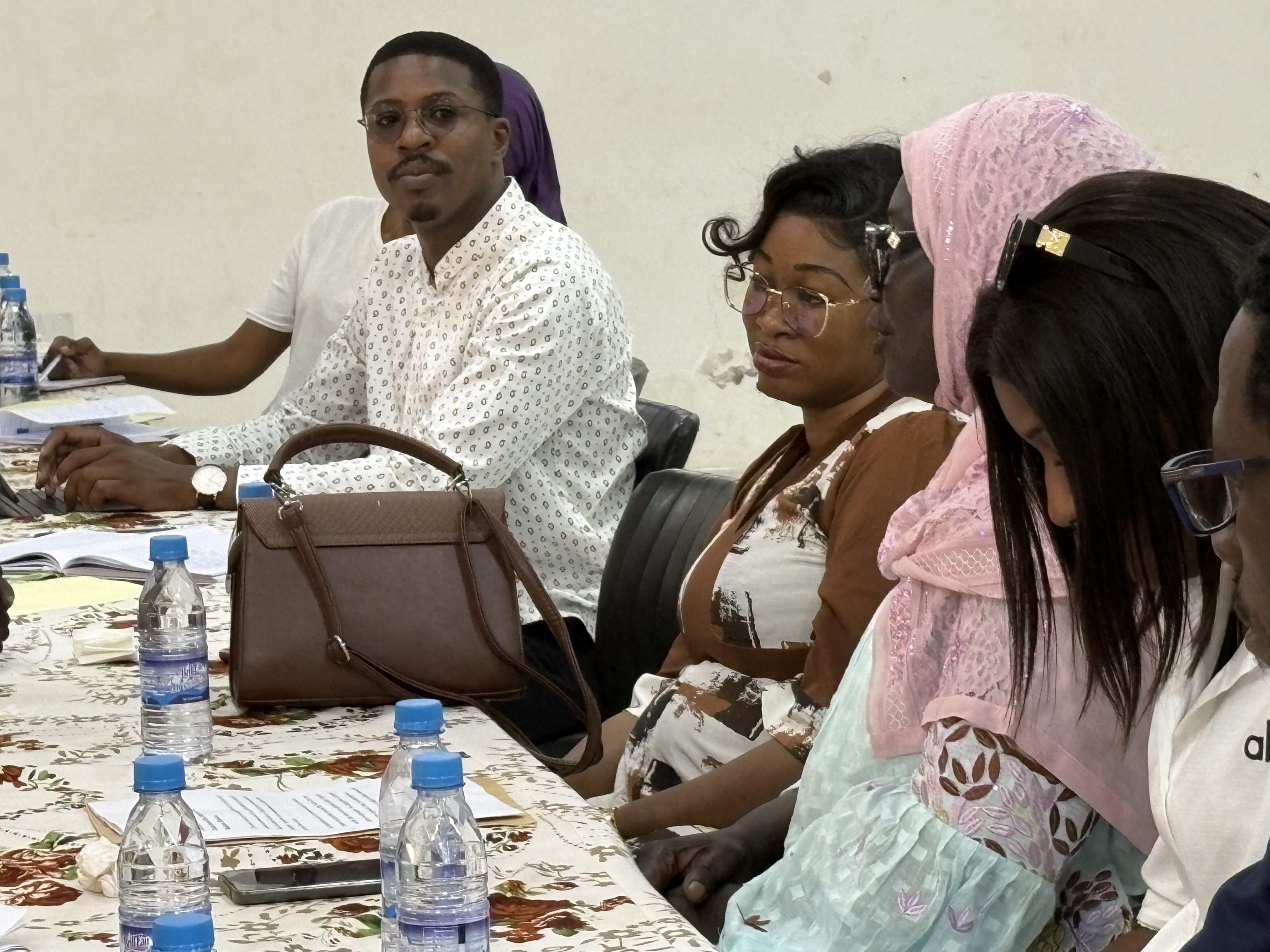
Advocacy meeting on menstrual health management in Kaolack, alongside the Association Actions pour le Développement du Sénégal (AADS) and local stakeholders.
Organizational development and entrepreneurship support provided to AADS and to women entrepreneurs involved in a locally driven menstrual health initiative in Kaolack.
A Project at the Intersection of Dignity, Education and Empowerment
In Kaolack, menstrual health is connected to a much broader set of issues: girls’ health and dignity, their self-confidence, their ability to remain fully engaged in school, access to appropriate sanitation facilities, and the willingness of families and institutions to address menstruation openly and without stigma.
Against this backdrop, the Association Actions pour le Développement du Sénégal (AADS), under the leadership of its President, Ms. Ndeye Gnilane Faye, led a project focused on strengthening girls’ ability to manage their menstrual health, with financial support from the Embassy of the Kingdom of the Netherlands in Senegal.
The initiative brought together schools, families, education authorities, local institutions and community stakeholders around a shared objective: improving knowledge and conditions related to menstrual health while giving girls greater agency over the issues that directly affect them.
Enabling Girls to Speak for Themselves
This was one of the aspects of the project that resonated most strongly with me.
Beyond awareness-raising and access to menstrual products, the girls were supported in building confidence, developing public speaking skills and learning how to articulate their concerns directly to decision-makers.
That approach matters. A project designed for girls becomes more meaningful when it does not simply speak about them, but also gives them the tools and space to speak for themselves, define their own concerns and bring those concerns directly to the people in a position to act.
In 2025, 568 girls across 19 secondary schools received direct training on menstrual health management and self-esteem. The activities also helped create more open conversations with parents and, in some schools, encouraged the formation of groups involved in maintaining school sanitation facilities.
Making Local Production Part of the Solution
Another important component of the project focused on the production of washable, reusable menstrual pads.
AADS trained 38 mothers of students in their production. The women later created a group with the aim of developing a local production unit, while AADS also built a pool of trained facilitators to help sustain the initiative over time.
As part of my mandate as an Organizational Development and Entrepreneurship Advisor, I supported women entrepreneurs trained by AADS and involved in this production process. My contribution focused in particular on strengthening their entrepreneurial approach and helping them think through the conditions required to develop the activity in a more structured and sustainable way.
I found this model particularly compelling because it connects several dimensions that are too often addressed separately: menstrual health, women’s economic empowerment, local skills development and the use of reusable products that reduce reliance on single-use alternatives.
By the end of the project, 15,352 reusable menstrual pads had been distributed to beneficiaries.
Sustaining the Impact Beyond the Funding Cycle
A project of this nature cannot achieve lasting impact without sustained engagement from institutions.
Throughout the initiative, several practical issues were brought into the discussion: access to running water, the condition and maintenance of school toilets, sanitation facilities adapted to girls’ needs, resource mobilization and the long-term involvement of local and education authorities.
The involvement of education authorities played an important role in facilitating implementation, while the appointment of a focal point within the local education system helped strengthen follow-up and coordination with participating schools.
The advocacy meeting with the Kaolack Departmental Council formed part of this broader effort to sustain the project’s achievements. It provided an opportunity to present results, discuss challenges faced by schools, address the need for improved sanitation infrastructure and continue the dialogue around integrating menstrual health more sustainably into local policies and budgets.
My Contribution
My involvement formed part of a project initiated and led by AADS under the leadership of its President, Ms. Ndeye Gnilane Faye.
In my role as an Organizational Development and Entrepreneurship Advisor, I supported the organization as part of my mandate and worked with women entrepreneurs involved in the production of reusable menstrual pads.
This experience allowed me to contribute, within my own area of expertise, to a much broader initiative led by AADS and its partners. It also gave me the opportunity to observe how a local organization can connect capacity development, women’s economic empowerment, menstrual health, education and institutional advocacy within a single intervention.
My role was not to replace the organization, its leadership or the teams that designed and implemented the project. It was to contribute, in a clearly defined capacity, to strengthening some of the organizational and entrepreneurial capabilities needed to support implementation and continuity.
What I Take Away from This Project
One conviction stands out for me: providing girls with practical resources matters, but giving them the ability to speak for themselves matters just as much.
When the people most directly affected by an issue are able to understand it, name it and express it directly to those with decision-making power, an intervention moves beyond assistance. It begins to build agency.
And when women within the same community develop the skills to produce part of the solution locally, another form of value is created: social needs meet local capabilities, and entrepreneurship itself becomes part of the response.
This is precisely the kind of intersection between local organizations, human capabilities, entrepreneurship and social impact that defines an important part of my work in organizational development.
Project Highlights
Lead organization
Association Actions pour le Développement du Sénégal (AADS)
Leadership
Ms. Ndeye Gnilane Faye, President
Funding partner
Embassy of the Kingdom of the Netherlands in Senegal
Location Kaolack, Senegal
My contribution
Organizational development and entrepreneurship advisory support, including support to AADS and to women entrepreneurs involved in the production of reusable menstrual pads.
Key results
19 secondary schools reached · 568 girls trained · 38 mothers trained in the production of washable menstrual pads · more than 2,370 people engaged through community forums · 15,352 reusable menstrual pads distributed.