
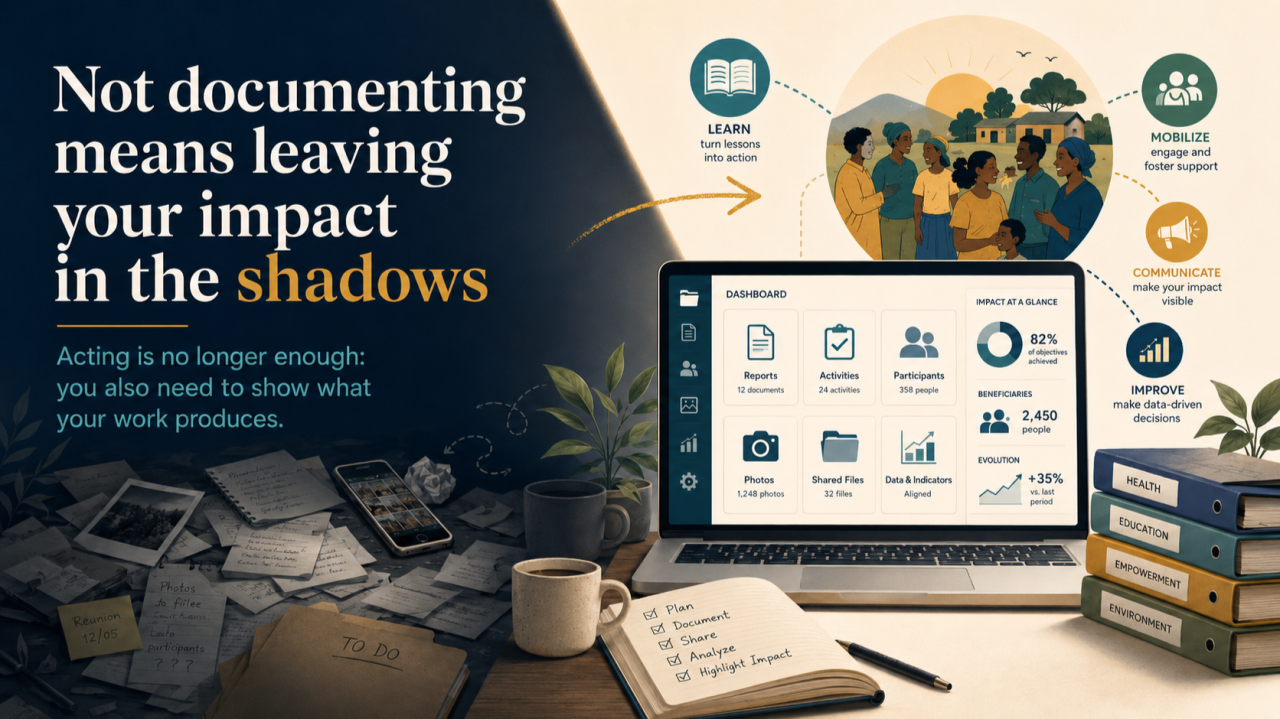
Acting is no longer enough: you also need to show what your work produces.
An organization can do serious work, support people, mobilize teams, and achieve real results, yet still struggle to show clearly what its work has produced.
This is where documentation becomes a real organizational development issue.
Documenting impact is not just about preparing a report at the end of a project. It is about creating the conditions for the work to be understood, verified, shared, improved, and used at the right time.
An organization that documents well does more than keep records. It builds a clear base for understanding what was done, what changed, and what can be improved. It reassures partners, supports teams, protects the people it serves, and prepares itself for future opportunities.
Many valuable actions remain invisible, not because they lack value, but because they did not leave enough evidence to be understood, recognized, and used later.
Documentation is not just about producing a report
Many organizations still associate documentation with the final report. They document because a funder asks for it, because a project is ending, or because an administrative requirement must be met.
That is part of the work, but it is not the full value of documentation.
To document is to keep useful records of what happens before, during, and after an action. It means knowing who was supported, which activities were carried out, which decisions were made, which difficulties appeared, what was adjusted, and how things evolved over time.
An organization that documents well is not only responding to an external request. It is also working for itself.
It understands its own actions better. It learns from experience. It avoids starting from zero every time. It can explain its work more clearly and make better decisions.
Documentation is therefore not just an administrative exercise. It is a tool for management, credibility, and learning.
A documentation framework supports the teams
Documentation should not depend only on the goodwill of staff, volunteers, or field teams.
In many organizations, information remains scattered. Notes sit in personal notebooks. Photos from activities are stored on everyone’s phones, and sometimes on no one’s in particular. Attendance lists are kept in different folders. Meeting notes are not always filed. Follow-ups are hidden in messages, emails, personal files, or forgotten conversations.
The problem is not always that teams do not want to document. Often, the organization itself has not created the right framework.
That framework matters.
It helps everyone know what should be documented, who is responsible, which tool should be used, when it should be done, and where the information should be stored. It prevents each person from inventing their own method. It reduces information loss. It also makes continuity easier when an employee leaves, when a volunteer changes role, or when a project moves from one team to another.
It is also a way of respecting the people who work within the organization.
An employee, volunteer, or field worker can quickly become discouraged if everything depends on their memory, personal notes, phone, or ability to recover scattered information. Documentation should not become an individual mental burden. It should be supported by simple rules, shared tools, and healthy habits.
This can begin with very practical steps: assigning someone to take photos during an activity, using a device or storage account that belongs to the organization, creating a well-named shared folder, keeping attendance lists in one place, preparing a short activity follow-up form, or using a simple template for meeting notes.
Today, there are also accessible tools to present work more professionally. An activity report no longer has to be a heavy, poorly structured, hard-to-read document. Tools such as Canva, presentation templates, simple dashboards, and collaborative workspaces can help organizations produce reports that are clearer, more visual, and more professional.
The goal is to make information clearer, better organized, and more pleasant to consult. When a report is well presented, people are more likely to read it, share it, and use it.
When this framework exists, teams work better. They know where to find information, how to share it, how to follow a decision, and how to report on an activity. It reduces mental load, improves productivity, and strengthens the quality of the work.
Clear records build trust
An organization that documents well inspires trust.
It reassures funders, partners, institutions, board members, general assemblies, teams, beneficiaries, and the public. It shows that the organization does not operate only through urgency, memory, or improvisation.
When an organization keeps records of its meetings, decisions, activities, follow-ups, exchanges with beneficiaries, expenses, results, and relationships with partners, it helps others understand how it works.
People can better understand what the organization does, how it works, what decisions were made, how a project is evolving, why an expense was made, or where a difficulty appeared.
This matters because an organization that keeps clear information on its internal and external interactions inspires greater confidence. It shows that it knows how to organize information, follow through on commitments, and make its work understandable.
In an environment where trust matters, that ability becomes a strength.
What is not documented becomes difficult to prove
In the life of an organization, there is always a moment when someone asks for proof.
A funder may want to understand how funding was used. A partner may ask for results. An institution may need to verify information. A board or general assembly may want to follow the progress of a project. A participant may need a certificate, a supporting document, or proof of participation.
At that moment, documentation becomes essential.
Without clear records, even a real action can become difficult to explain. You may know the work was done, but still be unable to demonstrate it properly.
And sometimes, this does not only concern the organization. A person who was supported may later need a certificate, a document, or proof of participation to defend their path, access an opportunity, or explain an important step in their journey.
Documenting is therefore also a way of protecting the people an organization supports.
It gives them the possibility, when they need it, to find a record, a document, or a form of proof that can help them.
Good documentation can also support others
An organization does not document only for itself.
In many projects, organizations work in partnership, in consortiums, or in arrangements where several actors contribute to the same intervention. In these contexts, good documentation can also help others.
One organization may sometimes hold more precise information than a partner: a list of participants, meeting notes, proof of an activity, monitoring data, a photo, an exchange with a beneficiary, a financial document, or a record of a decision.
When a question arises, these elements can help clarify a situation, complete a file, prepare a new proposal, or justify an action carried out collectively.
That is also the strength of a well-structured organization. It does not keep records only for itself. It contributes to the shared memory of the projects in which it participates.
Of course, not all data is useful in the same way. The point is not to accumulate everything without purpose. Information must be organized, confidentiality must be respected, people must be protected, and the organization must know what deserves to be kept.
But an organization that documents well can defend itself better, support its partners better, and position itself more effectively when new opportunities arise.
Organizations that document well position themselves faster
Opportunities often arrive sooner than expected: a call for proposals, available funding, a possible partnership, a collaboration request, an invitation to present work, or a chance to join a larger program.
In those moments, organizations that document well have a real advantage.
They do not need to rebuild everything in a hurry. They can retrieve their data, results, photos, reports, lists, testimonies, budgets, evidence, tools, and lessons learned.
They respond faster. They present themselves more clearly. They show what they have already done. They make a stronger case.
An organization that does not document often has to search, reconstruct, ask around, guess, or explain without enough evidence.
An organization that documents moves forward with substance.
And in an environment where funding and partnerships are often competitive, that difference matters.
Funders do not fund good intentions alone
Funders, foundations, institutions, and larger organizations do not look only at the will to act.
They also want to understand whether an organization can manage, track, explain, learn, and report.
They want to know what was done, with which resources, for whom, with what results, and what lessons were learned. They also want to see whether the organization can use resources seriously, transparently, and usefully.
Good documentation strengthens that confidence.
It shows that the organization does not work only in the immediacy of action. It shows that it knows how to keep records, track decisions, justify expenses, understand results, and learn from what it does.
This matters for reports, finances, audits, tax obligations, public communication, and future funding applications.
An organization that documents well does not only become more organized.
It becomes more credible.
Organizations should not always wait to equip themselves
Funders can help. Some even support organizational strengthening, digital tools, internal management, or monitoring capacity.
But an organization should not always wait for external funding to solve everything before it begins documenting its work better.
Of course, resources are often limited. Teams may be small. Time is short. Priorities are many. But today, there are more and more accessible, free, or low-cost tools that allow organizations to take a first step.
A well-organized storage space, simple forms, a tracking table, a project management tool, an accessible CRM, or an accounting solution adapted to the size of the organization can already improve the way work is managed.
A CRM (Customer Relationship Management) is generally translated as customer relationship management. It is used to track interactions with the people and organizations one works with. In an association, a civil society organization, or a development program, we may speak of participants, beneficiaries, members, partners, or donors rather than customers, but the logic is the same: keeping a clear record of exchanges, follow-ups, and the evolution of each relationship.
It is not about modernizing everything at once. It is about changing the posture.
Equipping the organization gradually, even with modest means, sends an important signal. It shows that the organization takes its work seriously, wants to learn, wants to be accountable, and is preparing to manage greater responsibilities.
An organization does not structure itself only because a funder requires it.
It also structures itself because it wants to be ready when opportunities arise.
Documenting is now much more accessible
The market for digital tools has become much more open. Today, there are solutions adapted to different budgets and different levels of organizational maturity.
What used to be available mainly to large organizations is now increasingly accessible to smaller ones, as long as they choose tools that are simple, useful, and truly adapted to their daily reality.
A project management tool can help track tasks, deadlines, responsibilities, and activity progress. An accounting tool can connect expenses, income, supporting documents, and budgets. Digital forms can make field data collection easier. Dashboards can help teams read results more clearly. Shared storage spaces can prevent the loss of documents.
Some tools can even connect several dimensions of the work: contacts, activities, follow-ups, documents, tasks, expenses, and reports. A registration can feed a database. An activity can be linked to a participant. An expense can be attached to a project. Information collected in the field can later become useful for a decision, a funding application, or a public presentation.
In some countries, Google Workspace for Nonprofits may also be offered free of charge to eligible organizations, helping them better organize emails, documents, forms, shared files, and teamwork.
Artificial intelligence, when used carefully, can also help some teams classify information, summarize notes, prepare draft reports, or better organize ideas.
The goal is not to replace human judgment.
The goal is to save time, reduce information loss, and make better use of what the organization already knows.
Documenting also means observing change over time
Good documentation should not only say what was done.
It should also show how things evolve.
An activity may be completed, but impact is often seen later: in what people change, what they continue to do, the difficulties they overcome, the habits they develop, the resources they mobilize, or the confidence they gain.
A report that says “we trained 50 people” provides useful information, but it remains limited. A follow-up that shows that some participants launched an activity, improved their income, joined a network, found a job, regained confidence, or continued using the tools they received tells a much stronger story.
Documenting means following the evolution.
It means observing what has changed since the beginning, what works better than before, what remains difficult, what was adjusted, what continues after the end of an activity, and what the people supported can do today that they could not do before.
Impact is not visible only in the activity delivered.
It is also visible in what changes afterward.
Data gives an organization strength
In today’s world, an organization that knows how to organize its data has more capacity to act.
This is not about collecting information just to fill files. It is about having solid elements to understand, decide, explain, convince, and anticipate.
An organization that knows its beneficiaries, results, costs, partners, interactions, difficulties, and lessons learned can manage its work more effectively.
It can also defend its position better.
It knows what it has done. It knows whom it has worked with. It knows what has changed. It knows what can be improved. It knows what it can present to a funder, a partner, an institution, or the public.
In many contexts, the ability to act also depends on the ability to rely on clear information.
Put simply, organizations that know how to organize their data have more means to understand, decide, and position themselves.
Well-managed data is not just an archive.
It is proof, memory, a decision-making tool, and a strength for the future.
Documenting is a way to capitalize on experience
Every project leaves something behind.
Results, of course. But also mistakes, methods, tools, contacts, stories, decisions, adjustments, and lessons.
If nothing is documented, each new project risks starting almost from zero.
By contrast, an organization that documents can capitalize on its experience.
It can reuse what worked, avoid certain mistakes, train new teams more easily, improve its practices, show its evolution over time, and turn experience into expertise.
That difference matters.
An organization that documents does not only keep archives.
It builds its collective intelligence.
What to remember
Many valuable actions remain invisible because they are not sufficiently documented.
The work exists. The efforts are real. The results may be there. But without clear records, part of that value disappears.
Documenting impact does not mean complicating the work of organizations. It means creating a simple framework to keep useful records of what is done, what changes, what is learned, and what can be improved.
It is useful for teams, beneficiaries, funders, general assemblies, finances, partners, the public, and the future of the organization.
In a world where opportunities often require evidence, an organization that documents well has a real advantage.
Because it does not simply say that it acts.
Acting is no longer enough: you also need to show what your work produces.
An organization can do serious work, support people, mobilize teams, and achieve real results, yet still struggle to show clearly what its work has produced.
This is where documentation becomes a real organizational development issue.
Documenting impact is not just about preparing a report at the end of a project. It is about creating the conditions for the work to be understood, verified, shared, improved, and used at the right time.
An organization that documents well does more than keep records. It builds a clear base for understanding what was done, what changed, and what can be improved. It reassures partners, supports teams, protects the people it serves, and prepares itself for future opportunities.
Many valuable actions remain invisible, not because they lack value, but because they did not leave enough evidence to be understood, recognized, and used later.
Documentation is not just about producing a report
Many organizations still associate documentation with the final report. They document because a funder asks for it, because a project is ending, or because an administrative requirement must be met.
That is part of the work, but it is not the full value of documentation.
To document is to keep useful records of what happens before, during, and after an action. It means knowing who was supported, which activities were carried out, which decisions were made, which difficulties appeared, what was adjusted, and how things evolved over time.
An organization that documents well is not only responding to an external request. It is also working for itself.
It understands its own actions better. It learns from experience. It avoids starting from zero every time. It can explain its work more clearly and make better decisions.
Documentation is therefore not just an administrative exercise. It is a tool for management, credibility, and learning.
A documentation framework supports the teams
Documentation should not depend only on the goodwill of staff, volunteers, or field teams.
In many organizations, information remains scattered. Notes sit in personal notebooks. Photos from activities are stored on everyone’s phones, and sometimes on no one’s in particular. Attendance lists are kept in different folders. Meeting notes are not always filed. Follow-ups are hidden in messages, emails, personal files, or forgotten conversations.
The problem is not always that teams do not want to document. Often, the organization itself has not created the right framework.
That framework matters.
It helps everyone know what should be documented, who is responsible, which tool should be used, when it should be done, and where the information should be stored. It prevents each person from inventing their own method. It reduces information loss. It also makes continuity easier when an employee leaves, when a volunteer changes role, or when a project moves from one team to another.
It is also a way of respecting the people who work within the organization.
An employee, volunteer, or field worker can quickly become discouraged if everything depends on their memory, personal notes, phone, or ability to recover scattered information. Documentation should not become an individual mental burden. It should be supported by simple rules, shared tools, and healthy habits.
This can begin with very practical steps: assigning someone to take photos during an activity, using a device or storage account that belongs to the organization, creating a well-named shared folder, keeping attendance lists in one place, preparing a short activity follow-up form, or using a simple template for meeting notes.
Today, there are also accessible tools to present work more professionally. An activity report no longer has to be a heavy, poorly structured, hard-to-read document. Tools such as Canva, presentation templates, simple dashboards, and collaborative workspaces can help organizations produce reports that are clearer, more visual, and more professional.
The goal is to make information clearer, better organized, and more pleasant to consult. When a report is well presented, people are more likely to read it, share it, and use it.
When this framework exists, teams work better. They know where to find information, how to share it, how to follow a decision, and how to report on an activity. It reduces mental load, improves productivity, and strengthens the quality of the work.
Clear records build trust
An organization that documents well inspires trust.
It reassures funders, partners, institutions, board members, general assemblies, teams, beneficiaries, and the public. It shows that the organization does not operate only through urgency, memory, or improvisation.
When an organization keeps records of its meetings, decisions, activities, follow-ups, exchanges with beneficiaries, expenses, results, and relationships with partners, it helps others understand how it works.
People can better understand what the organization does, how it works, what decisions were made, how a project is evolving, why an expense was made, or where a difficulty appeared.
This matters because an organization that keeps clear information on its internal and external interactions inspires greater confidence. It shows that it knows how to organize information, follow through on commitments, and make its work understandable.
In an environment where trust matters, that ability becomes a strength.
What is not documented becomes difficult to prove
In the life of an organization, there is always a moment when someone asks for proof.
A funder may want to understand how funding was used. A partner may ask for results. An institution may need to verify information. A board or general assembly may want to follow the progress of a project. A participant may need a certificate, a supporting document, or proof of participation.
At that moment, documentation becomes essential.
Without clear records, even a real action can become difficult to explain. You may know the work was done, but still be unable to demonstrate it properly.
And sometimes, this does not only concern the organization. A person who was supported may later need a certificate, a document, or proof of participation to defend their path, access an opportunity, or explain an important step in their journey.
Documenting is therefore also a way of protecting the people an organization supports.
It gives them the possibility, when they need it, to find a record, a document, or a form of proof that can help them.
Good documentation can also support others
An organization does not document only for itself.
In many projects, organizations work in partnership, in consortiums, or in arrangements where several actors contribute to the same intervention. In these contexts, good documentation can also help others.
One organization may sometimes hold more precise information than a partner: a list of participants, meeting notes, proof of an activity, monitoring data, a photo, an exchange with a beneficiary, a financial document, or a record of a decision.
When a question arises, these elements can help clarify a situation, complete a file, prepare a new proposal, or justify an action carried out collectively.
That is also the strength of a well-structured organization. It does not keep records only for itself. It contributes to the shared memory of the projects in which it participates.
Of course, not all data is useful in the same way. The point is not to accumulate everything without purpose. Information must be organized, confidentiality must be respected, people must be protected, and the organization must know what deserves to be kept.
But an organization that documents well can defend itself better, support its partners better, and position itself more effectively when new opportunities arise.
Organizations that document well position themselves faster
Opportunities often arrive sooner than expected: a call for proposals, available funding, a possible partnership, a collaboration request, an invitation to present work, or a chance to join a larger program.
In those moments, organizations that document well have a real advantage.
They do not need to rebuild everything in a hurry. They can retrieve their data, results, photos, reports, lists, testimonies, budgets, evidence, tools, and lessons learned.
They respond faster. They present themselves more clearly. They show what they have already done. They make a stronger case.
An organization that does not document often has to search, reconstruct, ask around, guess, or explain without enough evidence.
An organization that documents moves forward with substance.
And in an environment where funding and partnerships are often competitive, that difference matters.
Funders do not fund good intentions alone
Funders, foundations, institutions, and larger organizations do not look only at the will to act.
They also want to understand whether an organization can manage, track, explain, learn, and report.
They want to know what was done, with which resources, for whom, with what results, and what lessons were learned. They also want to see whether the organization can use resources seriously, transparently, and usefully.
Good documentation strengthens that confidence.
It shows that the organization does not work only in the immediacy of action. It shows that it knows how to keep records, track decisions, justify expenses, understand results, and learn from what it does.
This matters for reports, finances, audits, tax obligations, public communication, and future funding applications.
An organization that documents well does not only become more organized.
It becomes more credible.
Organizations should not always wait to equip themselves
Funders can help. Some even support organizational strengthening, digital tools, internal management, or monitoring capacity.
But an organization should not always wait for external funding to solve everything before it begins documenting its work better.
Of course, resources are often limited. Teams may be small. Time is short. Priorities are many. But today, there are more and more accessible, free, or low-cost tools that allow organizations to take a first step.
A well-organized storage space, simple forms, a tracking table, a project management tool, an accessible CRM, or an accounting solution adapted to the size of the organization can already improve the way work is managed.
A CRM (Customer Relationship Management) is generally translated as customer relationship management. It is used to track interactions with the people and organizations one works with. In an association, a civil society organization, or a development program, we may speak of participants, beneficiaries, members, partners, or donors rather than customers, but the logic is the same: keeping a clear record of exchanges, follow-ups, and the evolution of each relationship.
It is not about modernizing everything at once. It is about changing the posture.
Equipping the organization gradually, even with modest means, sends an important signal. It shows that the organization takes its work seriously, wants to learn, wants to be accountable, and is preparing to manage greater responsibilities.
An organization does not structure itself only because a funder requires it.
It also structures itself because it wants to be ready when opportunities arise.
Documenting is now much more accessible
The market for digital tools has become much more open. Today, there are solutions adapted to different budgets and different levels of organizational maturity.
What used to be available mainly to large organizations is now increasingly accessible to smaller ones, as long as they choose tools that are simple, useful, and truly adapted to their daily reality.
A project management tool can help track tasks, deadlines, responsibilities, and activity progress. An accounting tool can connect expenses, income, supporting documents, and budgets. Digital forms can make field data collection easier. Dashboards can help teams read results more clearly. Shared storage spaces can prevent the loss of documents.
Some tools can even connect several dimensions of the work: contacts, activities, follow-ups, documents, tasks, expenses, and reports. A registration can feed a database. An activity can be linked to a participant. An expense can be attached to a project. Information collected in the field can later become useful for a decision, a funding application, or a public presentation.
In some countries, Google Workspace for Nonprofits may also be offered free of charge to eligible organizations, helping them better organize emails, documents, forms, shared files, and teamwork.
Artificial intelligence, when used carefully, can also help some teams classify information, summarize notes, prepare draft reports, or better organize ideas.
The goal is not to replace human judgment.
The goal is to save time, reduce information loss, and make better use of what the organization already knows.
Documenting also means observing change over time
Good documentation should not only say what was done.
It should also show how things evolve.
An activity may be completed, but impact is often seen later: in what people change, what they continue to do, the difficulties they overcome, the habits they develop, the resources they mobilize, or the confidence they gain.
A report that says “we trained 50 people” provides useful information, but it remains limited. A follow-up that shows that some participants launched an activity, improved their income, joined a network, found a job, regained confidence, or continued using the tools they received tells a much stronger story.
Documenting means following the evolution.
It means observing what has changed since the beginning, what works better than before, what remains difficult, what was adjusted, what continues after the end of an activity, and what the people supported can do today that they could not do before.
Impact is not visible only in the activity delivered.
It is also visible in what changes afterward.
Data gives an organization strength
In today’s world, an organization that knows how to organize its data has more capacity to act.
This is not about collecting information just to fill files. It is about having solid elements to understand, decide, explain, convince, and anticipate.
An organization that knows its beneficiaries, results, costs, partners, interactions, difficulties, and lessons learned can manage its work more effectively.
It can also defend its position better.
It knows what it has done. It knows whom it has worked with. It knows what has changed. It knows what can be improved. It knows what it can present to a funder, a partner, an institution, or the public.
In many contexts, the ability to act also depends on the ability to rely on clear information.
Put simply, organizations that know how to organize their data have more means to understand, decide, and position themselves.
Well-managed data is not just an archive.
It is proof, memory, a decision-making tool, and a strength for the future.
Documenting is a way to capitalize on experience
Every project leaves something behind.
Results, of course. But also mistakes, methods, tools, contacts, stories, decisions, adjustments, and lessons.
If nothing is documented, each new project risks starting almost from zero.
By contrast, an organization that documents can capitalize on its experience.
It can reuse what worked, avoid certain mistakes, train new teams more easily, improve its practices, show its evolution over time, and turn experience into expertise.
That difference matters.
An organization that documents does not only keep archives.
It builds its collective intelligence.
What to remember
Many valuable actions remain invisible because they are not sufficiently documented.
The work exists. The efforts are real. The results may be there. But without clear records, part of that value disappears.
Documenting impact does not mean complicating the work of organizations. It means creating a simple framework to keep useful records of what is done, what changes, what is learned, and what can be improved.
It is useful for teams, beneficiaries, funders, general assemblies, finances, partners, the public, and the future of the organization.
In a world where opportunities often require evidence, an organization that documents well has a real advantage.
Because it does not simply say that it acts.
It can show what it does, understand what it produces, support the people and partners concerned, and present itself with greater strength when the right opportunity appears.